
PERFORMANCE CINÉMA-MUSIQUE
CELLULE D’INTERVENTION METAMKINE
CHRISTOPHE AUGER and XAVIER QUÉREL 6x16mm film and projectors
JÉRÔME NOETINGER electro-acoustic dispositive
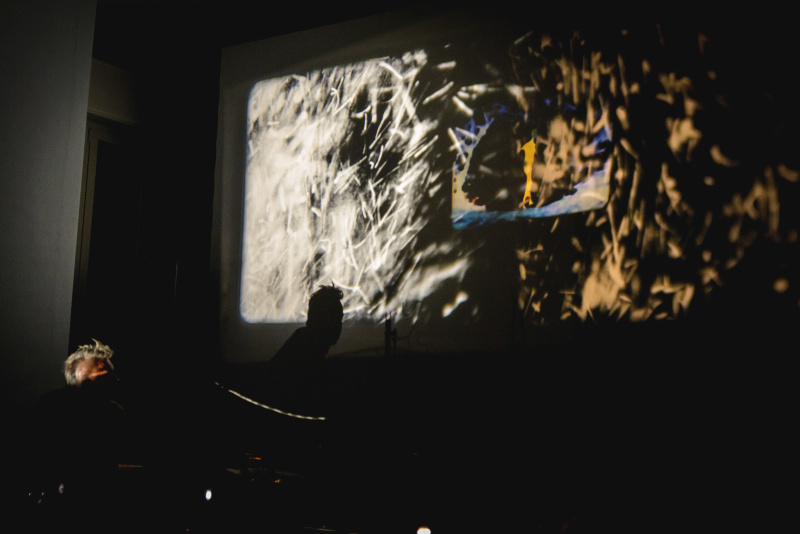
For the next forty minutes, La Cellule d’Intervention Metamkine, a live performance trio from Grenoble, fuses the worlds of expanded cinema and improvisatory music in a visceral live experience, reminiscent of the sound and light shows of the 1960s and ’70s that attempted to go beyond the possibilities of a single image and a single screen. The two projectionists in Metamkine move between six 16mm film projectors and an assortment of filters, lights, and visual tricks, building layers of images on top of each other. Shadows of projectors are cast onto the screen, film celluloid melts and live chemical processing of film stock induces visual transformations. Meanwhile, a musician uses radio waves, electrical hums, and pre-recorded tape loops to both react to and spur on the filmic melee. Contact mikes attached to short-wave radios, electrical transformers, and various metal objects send sound waves through Revox tape recorders and Korg synthesizers to bend them into new shapes and pulses. At times, the music builds to a drone that matches a calmer onscreen section; at other times, the three performers produce a visual and sonic cacophony, intensely prodding one another in a growling and sputtering mechanical reverie. Sonically mirroring the actions of the projectionists, the musician deftly moves from one sound to the other, negotiating his mixing board to control the various electrical sounds he produces with his equipment.
Though film performance is a novel practice in itself, what further distinguishes Metamkine’s performance is that the three collaborators assume a band-like stance in front of the screen. They achieve this by aiming their multiple projectors towards the audience at two large-scale mirrors positioned to reflect the images back onto the screen. With audio interpretation of the events unfolding at centre stage and the image manipulation taking place before the audience, the conventions of classical stage set-up are contravened. Projectors normally relegated to a closed booth behind the audience now take the main stage, revealing the means of production in a structural strategy at the heart of Metamkine’s work.
Jérôme Noetinger, Xavier Quérel, and Christophe Auger, the trio that make up Metamkine, have been intervening in the traditions of film and sound art for the past fifteen years. As active members of an art scene based in Grenoble, they have developed a truly improvisational and independent artistic life: controlling how they produce, exhibit, and disseminate their images and sound, and openly sharing their knowledge with other like-minded artists.
This notion of independence is very important to Metamkine. As Auger states, “it’s important for us to live outside of Paris, where the main film centre is, and to be able to make film without much money. You just need film stock.” This independence also relies on a sense of interdependence, something that Noetinger does not see as much of in the music world. “To see the people of the Atelier working together to create seven or eight labs across France is really good… Musicians are not able to work together at the same level as a film co-op.”
…
This interdependence is also reflected in the trio’s performance style, which relies heavily on improvisation. They treat the projectors like musical instruments, with Quérel and Auger being able to quickly move from one to the other to keep up with the flow of the performance. Their proximity within the performance space keeps them attentive to each other’s movements. As Quérel states, “In performing live, we know each other, our styles; but it’s always completely based on live improvisation… I am very sensitive to the other projectors, listening to what is happening… This relationship that you can have is really important.” Noetinger, who performs regularly with Lionel Marchetti and MIMEO, amongst others, points out that the greatest difference in working with Auger and Quérel is that cinema creates a different sense of time. The pace is defined by the mechanical speed of the projector, which allows his musical responses to evolve at a slower speed. Otherwise, “when I’m working with Christophe and Xavier, I feel like they’re just musicians.”
When talking about their work, a key idea that the trio often brings up is the Situationist ideal of détournement. Coined by Guy Debord, détournement roughly translates into the idea of collage, putting two different things together to create something new and unintended. As Noetinger states, part of their art is “to show that the projector not only plays back the film, but it can be an instrument to act on directly. The image becomes just one part of it. It is like how I work with tape recorders. A tape recorder is meant to record music and play back in a certain way, but you can act on it in different ways. You can change its function to create something new. So, you can take something that is meant for a certain thing and play with it.” Noetinger often uses two tape recorders, one to play back pre-recorded sounds and the other to build loops using both the playback and recording heads simultaneously.
…
Noetinger continues, “After all, what is really important for me [is that] when I’m playing in this way, I’m really not making music for film. We’re not making film for music.” Watching a Metamkine performance reveals the truth of that. With their devotion to improvisation and to creating each performance anew, Metamkine has broken the pattern in which music is in servitude to film or vice versa. To this end, they have never released an album or a DVD. Nor is there a sound example on this issue’s Musicworks CD - because they feel that the live experience is not replicable. Sound, image, and the audience’s response to the performance all intertwine.
Halfway through their performance at the Soundplay festival in Toronto, Quérel ran to the back of the hall and used a light to project shadows of the audience onto the screen. It was a strong visual image for Metamkine’s sense of event and sense of community. Noetinger summed up the importance of the spectator to the completion of the performance: “I think the connection is more the way it is meant together. It is very open; it is up to you to see the connections. The audience is completely free to make the connections themselves.” A performance by Metamkine thus invites the audience to discover anew the possibilities of exploring sound and image as a collaborative experience.
Chris Kennedy
Excerpt from Three French artists place retro-tech at the heart of their unique, exclusively live music-cinematic creations originally published in Musicworks issue # 94, Spring 2006 www.musicworks.ca